Who Do You Say That I Am?
Jesus took His disciples to Caesarea Philippi.
A place carved into rock, thick with idols and superstition.
Caesarea Philippi was a pagan worship site. There were shrines cut into the cliff face. A cavern that people believed was a gate to the underworld. Sacrifices were thrown into the abyss in hopes that the gods would grant them favour.
If you wanted the divine to move in your life, this was the place you came to bargain.
Bring the right sacrifice.
Say the right words.
Perform the right ritual.
Maybe the gods would respond.
It was oppressive, transactional religion.
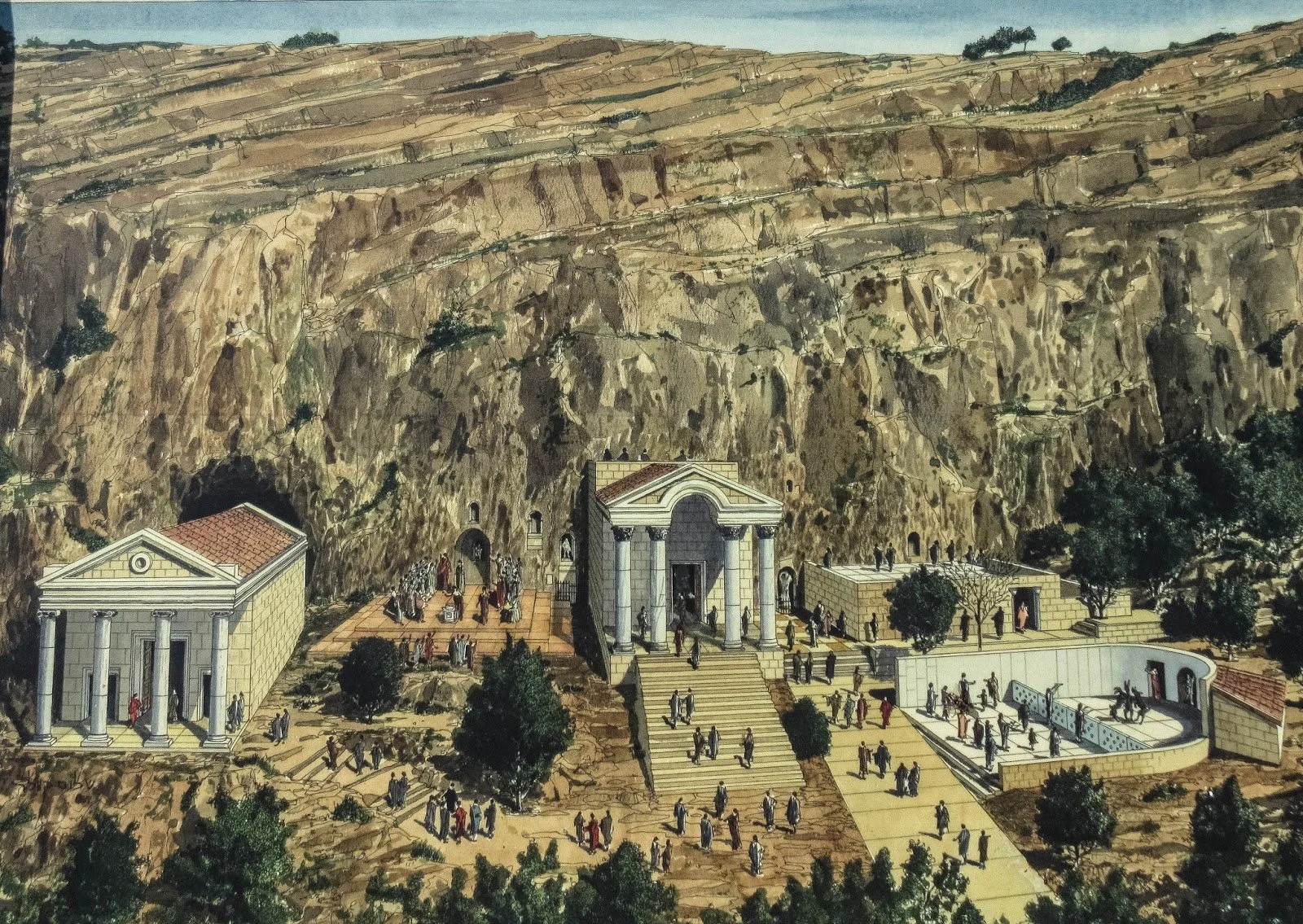
And in that place, under the backdrop of active pagan worship, Jesus asks a question.
“Who do people say that I am?”
The disciples answer him: John the Baptist. Elijah. Jeremiah. One of the prophets.
All safe answers. All familiar boxes. All ways of interpreting Jesus without surrendering to Him.
Now the most important question.
“Who do you say that I am?”
Peter speaks:
“You are the Christ, the Son of the living God.”
The living God.
Not carved into stone.
Not fed by sacrifices.
Not manipulated by ritual.
Living.
And Jesus responds: “Blessed are you… flesh and blood has not revealed this to you.” And then: “On this rock I will build my church, and the gates of Hades will not prevail against it.”
Standing in front of a literal rock face filled with idols. In front of what people believed were the gates of hell.
And Jesus says: On this rock I will build my church.
His sentence dismantles the pagan system entirely and the contrast could not be clearer.
At Caesarea Philippi, people climbed toward gods who demanded sacrifice.
In Christ, God stepped down toward humanity and became the sacrifice.
The idols required approach.
Christ initiates pursuit.
The idols were transactional.
Christ is transformative.
Transactional religion says: perform correctly and God will respond.
Transformative grace says: God has already stepped down—now trust Him.
As I sat with this passage, I sensed God’s spirit inviting me to answer this same question.
“Brent, who do you say that I am?”
This was not a theological endeavor rather a deeply personal one.
What am I going to do with Jesus?
Is He a my moral compass whose words I can take or leave?
Is He some sort of cosmic gumball machine—where if I insert enough prayer, obedience or sacrifice, blessings eventually fall out?
Is He my emergency therapist when life gets hard?
Or is He something far more foundational?
The Christ.
The Son of the living God.
The source of life itself.
Psalm 1 describes a blessed person as one who is “like a tree planted by streams of water, which yields its fruit in season and whose leaf does not wither.”
A tree does not bargain with the river.
It simply roots itself in its source of life.
And perhaps that is the invitation Jesus was offering His disciples—and still offers us.
The living God is not someone we climb toward or manipulate.
He is the One who has stepped down to pursue us.
And the question that determines the direction of our lives remains the same:
Who do you say that I am?
Because whatever our answer is—
That is the path we will walk.
Will we spend our lives climbing toward idols that promise favour?
Or will we root ourselves in the living Christ who alone gives life?
One path exhausts.
The other transforms.
