The Gift on the Other Side of Suffering
I spent a day recently at a luxurious spa, and in the quiet moments my mind was, somewhat ironically, turning over the biblical story of Job.
It is generally regarded as one of the oldest stories ever written, and it deals with perhaps the most universal of all human experiences:
Suffering.
Job’s world was so different from our own that it would be almost unrecognizable to our relatively comfortable lives.
He lived in a time when suffering was simply part of daily existence. People regularly died from disease, famine, accidents, violence, and even animal attacks. Children died. Parents died. Friends died. Life was fragile and uncertain.
Yet despite the temporary nature of life, people still attached themselves emotionally to spouses, children, friends, and communities, even though loss was inevitable.
People still chose to love.
Perhaps that has always been part of what it means to be human.
To love what cannot be kept forever.
In many ways, our modern world has insulated us from much of the suffering that previous generations considered normal. We enjoy comfort, convenience, and safety that would have been unimaginable for most of human history.
We have worked not only to eliminate suffering from the human condition, but inconvenience too.
Yet suffering still finds us.
Relationships fracture.
Dreams collapse.
Bodies fail.
People we love die.
No amount of technology has managed to solve the problem of loss.
When suffering arrived, Job was confronted by the same temptations that confront us.
His friends encouraged him to blame himself.
Surely he must have sinned.
Others might have chosen to curse God.
If God is good, then suffering must mean He has abandoned us.
Still others reach the darkest conclusion of all: if pain cannot be escaped, perhaps life itself should end.
Job wrestled with all of these realities.
He questioned God.
Argued with God.
Demanded answers from God.
But he never severed the relationship.
He contended with God.
That distinction has become increasingly important to me.
Contending with God is not the opposite of faith.
Sometimes it is faith in its most honest form.
For much of the story, Job hears nothing in response. He cries out, and heaven appears silent. He asks God to explain Himself, but no explanation comes.
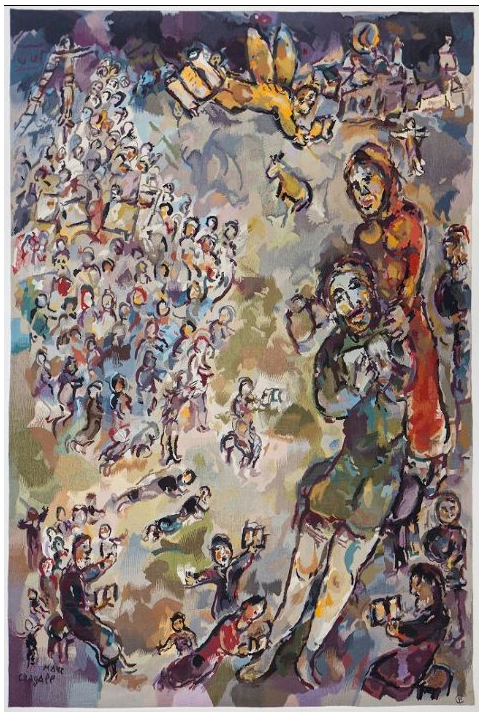
“Job” designed by Marc Chagall and located in the Shirley Ryan AbilityLab, Chicago, IL.
Many of us know something of that silence.
We pray for direction and receive none.
We plead for healing, relief, or even the smallest indication that God is near, and hear only the echo of our own voice.
We tend to interpret those seasons as evidence that God has stopped speaking.
But I wonder if the times we cannot hear God’s voice are often the times when He is speaking the loudest.
Not through explanations.
Not through immediate deliverance.
But through the deeper work He is doing within us.
The crucible of suffering burns away superficiality and ingratitude.
It also burns away superficial prayer.
We stop telling God what we think faithful people are supposed to say and begin offering Him what is actually there:
An angry heart.
A doubting heart.
Even a silent heart.
Perhaps that is the essence of faith in suffering—not maintaining a polished spirituality, but continuing to bring God our true heart.
This is the accusation that begins the story of Job:
“Does Job fear God for nothing?”
In other words, does Job love God, or only the life God has given him?
Take away the blessings, and we will discover what his faith is made of.
Job’s friends never escape a transactional understanding of God. They assume righteousness must produce blessing and suffering must indicate sin. Their theology leaves no room for undeserved pain, unexplained loss, or divine silence.
Job refuses their explanation.
He does not pretend to understand what has happened.
He does not accept responsibility for sins he did not commit.
He does not call evil good.
But neither does he abandon God.
He remains in the relationship, even when the relationship becomes a wrestling match.
What has always fascinated me is that when God finally speaks, He never really answers Job’s central question.
There is no detailed explanation.
No disclosure of the cosmic conflict that opened the book.
No satisfying answer to the question of “Why?”
Perhaps that is because the “why” answer rarely reduces the impact of loss.
Many people spend years spiralling emotionally, trying to pin the “why” tail on the proverbial donkey, only to discover that understanding does not undo grief.
An explanation cannot restore what was lost.
When God finally speaks, He does not give Job an explanation.
He gives Job Himself.
And somehow, that becomes enough.
At the end of the story, God restores Job’s fortunes, blesses him with children again, and multiplies what he once possessed.
For years, this ending felt to me like a cosmic consolation prize.
As if anything could simply replace what had been lost.
But the older I get, the more I wonder if that misses the point.
Perhaps the blessing was not merely that Job received more.
Perhaps the blessing was that Job had become someone different.
The first Job enjoyed his family, his health, his wealth, and his reputation.
The second Job knew he could lose all of it.
The first Job was grateful.
The second Job was grateful and aware.
That is the difference.
Those who persevere through deep suffering often emerge with a perspective that multiplies the meaning of every blessing that follows.
A person who has buried a spouse understands companionship more deeply.
Someone who has battled loneliness understands friendship more deeply.
A person who has stood at the edge of despair experiences ordinary joy with deeper meaning.
The blessing itself may not be greater.
But our capacity to appreciate it is enlarged.
Perhaps this is one reason gratitude often feels so elusive in our culture.
We spend enormous amounts of energy trying to avoid suffering.
We distract ourselves from it.
Medicate it.
Numb it.
Escape it.
There is, of course, wisdom in alleviating suffering where we can. Pain is not inherently virtuous, and we should never romanticize what is cruel, destructive, or unjust.
But there is also danger in believing that the purpose of life is the avoidance of pain.
Because if comfort becomes our expectation, every loss feels like an injustice.
And every blessing feels ordinary.
But those who have wrestled with God in the darkness, without giving up, often discover something different.
A sunrise becomes more beautiful.
A quiet conversation becomes more meaningful.
The laughter of family becomes more precious.
An ordinary day becomes a gift.
Job never received a satisfying explanation for his disproportionate suffering.
Most of us will not either.
Jesus Himself said, “In this world you will have trouble.”
Suffering is part of the human experience.
Yet God may be doing some of His deepest speaking when He appears to be silent.
Not by explaining everything.
Not by removing every pain.
But by teaching us to bring Him our true heart, trust that silence is not abandonment, and recognize grace with greater clarity.
Perhaps that is one of suffering’s unexpected gifts.
Our blessings are multiplied—not necessarily because we have more, but because the crucible has taught us how much they are worth.
