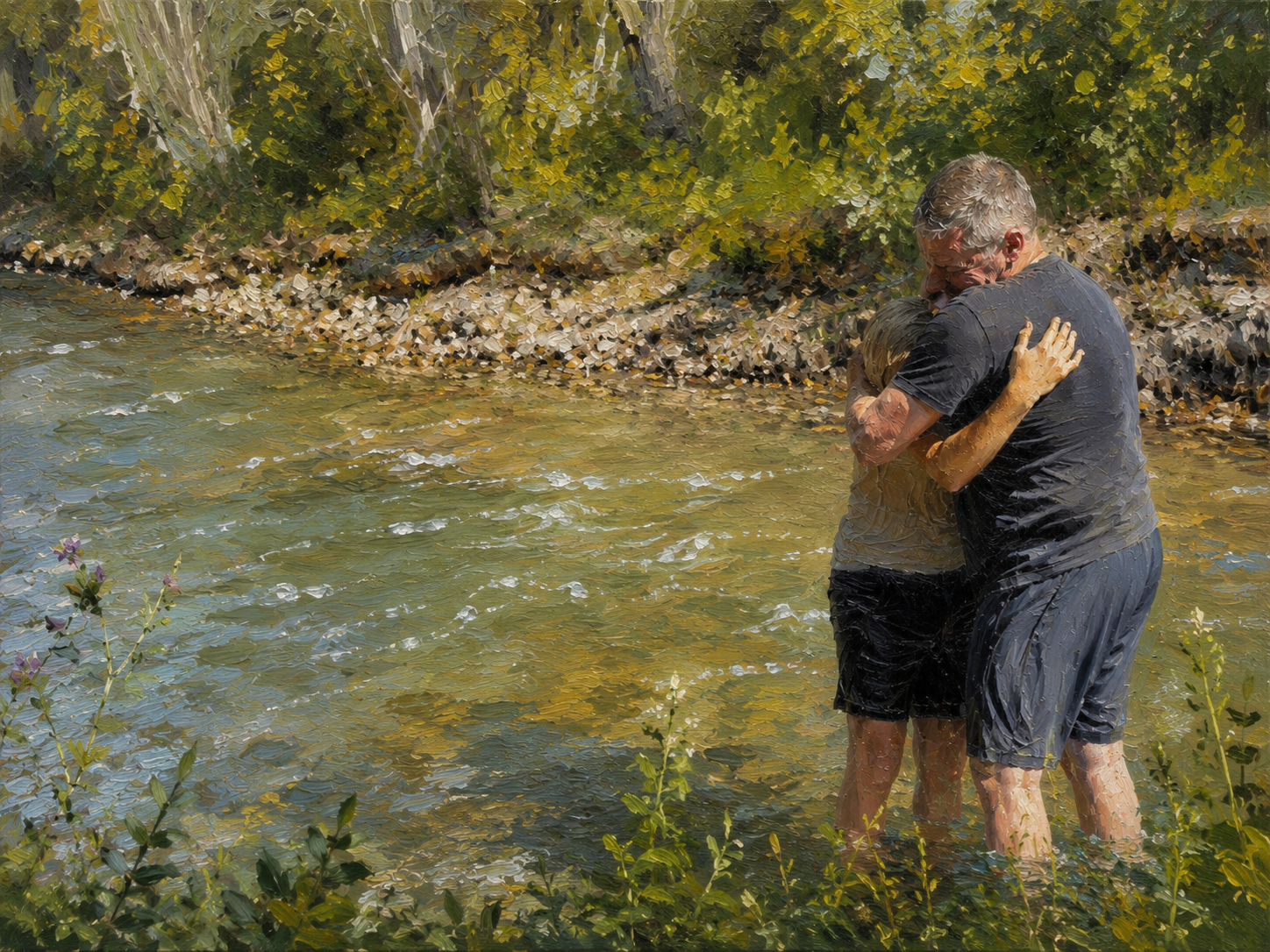
Last summer I had the privilege of baptizing my son in the cold water of the Bow River in Calgary.
After spending what seemed like an eternity finding the right location—accessible, somewhat private, and not in whitewater over rocks—we entered the river together and he proclaimed his faith in Christ.
It was a moving moment for both of us and one that I will carry for the rest of my life.
What I remember most, however, was what happened afterward.
When he came up out of the water, he was weeping.
His body shook like someone who had encountered something real. As his father, I can still picture that moment. I cannot fully explain what God was doing in his heart that day, but I know I was watching a young man publicly step into an identity that had become his own.
And God met him there.
Ironically, that moment also exposed a gap in my own understanding.
In all my years in church life and theological study, I had never really stopped to consider the full story of baptism outside of the New Testament. Where did this practice come from? Where did John the Baptist get the idea to start baptizing people? Why did Jesus Himself feel the need to be baptized?
One of the things I love about the Christian faith is that our practices are rich with meaning. What often appears simple on the surface is usually connected to a much deeper story that stretches throughout history.
Baptism is one of those practices.
Ritual cleansing was a regular part of Jewish life. People would wash to be made clean, especially before entering sacred spaces such as the temple. Water was never just water. It marked the boundary between impurity and purity, between being outside and being able to approach God.
So when John began calling people to be baptized, the act itself would not have seemed unusual. But everything else about it was.
Like so many practices that were ultimately fulfilled in Christ, it was familiar enough not to be dismissed but disruptive enough that it could not be ignored.
The location was certainly unusual—a river instead of the temple courts. Not controlled nor contained by religious systems. Just water, wilderness, and an invitation to repentance.
The more I reflected on it, the more I realized that passing through water had always carried significance for God's people.
Their story was marked by it.
The most obvious example is the crossing of the Red Sea. Israel passed through the waters, leaving behind slavery and stepping into freedom. The old life was swallowed up behind them, and a new identity was formed on the other side.
The language of baptism itself points in this direction. The Greek word baptizo simply means to immerse or plunge beneath the surface. It appears in Greek translations of the Old Testament in stories such as Naaman, who immersed himself in the Jordan River and emerged healed. What began as an act of washing became associated with restoration, healing, and renewed relationship with God.
Perhaps even more foundational is the opening chapter of Genesis itself. Before God formed the world, the Spirit hovered over the waters. Out of chaos came order. Out of emptiness came life.
Again and again throughout Scripture, water becomes the place where one thing ends and another begins.
Seen through that lens, baptism becomes more than a symbol of cleansing or a religious rite.
It becomes a declaration of identity.
As I stood in the Bow River with my son, I don't think his tears were primarily about water. Nor were they about a ritual, a church tradition, or even a public profession of faith.
I believe they were the response of a fourteen-year-old boy realizing that he belonged to God.
That is what baptism ultimately declares.
Not what we think about God.
Not what we promise to God.
But what God says about us.
You are mine.
Before the waters of the Red Sea parted, before Naaman entered the Jordan, before John stood in the wilderness calling people to repentance, before Jesus stepped into the river Himself, the story has always been the same.
God takes hold of ordinary people and calls them His own.
As someone who identifies with Christ and has been baptized into the faith, I also identify as someone who is moving from death to life. Someone who experiences the glory of God even through the waters of suffering. Someone who has left sin and shame beneath the surface and emerged clean.
The older I get, the more I realize that this is not just a theological truth or even a moment in time. It is an ongoing reality.
There are still places in my life where my spirit is catching up to what God has already declared to be true. There are still parts of me being transformed, restored, and renewed.
Baptism reminds me that my identity is not ultimately determined by my failures, my wounds, or even my present struggles.
My identity is found in Christ.
This is part of who I am. Not fully realized yet—but real nonetheless.
Perhaps that is the essence of the Kingdom of God. We live in the tension of the already and the not yet. God has already called us His own, already declared us clean, already begun His work of renewal within us.
And yet He is still completing that work.
Baptism reminds me that I belong to that story.
